
Morgan Sindall Begins £34m Owlstone Croft Passivhaus Student Accommodation for Queens' College, Cambridge
- Mar 26
- 5 min read
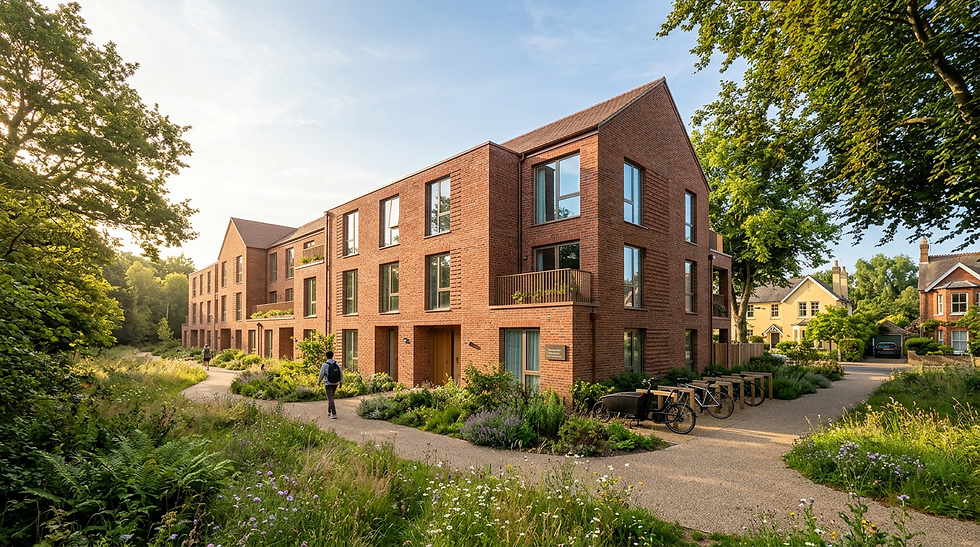
Morgan Sindall Construction has started work on the £34m Owlstone Croft postgraduate housing scheme for Queens' College, Cambridge, delivering one of the most sustainability-ambitious student accommodation projects in the university sector. The design-and-build project on Owlstone Road in Newnham will create new Passivhaus-standard homes and refurbish existing terrace buildings to Enerphit principles, completing by June 2027.
Project Overview
Location: Owlstone Croft, Owlstone Road, Newnham, Cambridge, CB3 9JJ.
Client: Queens' College, University of Cambridge.
Main contractor: Morgan Sindall Construction.
Contract value: £34m design and build.
Scope: New postgraduate housing in four terrace buildings; Blocks A and B refurbished, extended and decarbonised.
Sustainability standard: New buildings to Passivhaus certification; existing buildings to Enerphit (Passivhaus retrofit) principles.
Landscape: Extensive landscaping adjacent to Paradise Nature Reserve, Newnham.
Programme: July 2025 to June 2027.
College target: Net zero carbon footprint by 2045.
Stay Ahead of the Market
The construction market is moving fast, with new contracts, shifting pipelines, rising costs, and tightening regulations.
The professionals who win in 2026 are the ones with the right intelligence.
We publish market reports, contract guides, and BD tools built exclusively for construction professionals.
→ Browse the full resource library: emilecon.com/category/all-products
Delivery Partners and Key Stakeholders
Main contractor: Morgan Sindall Construction's Cambridge-based East business unit is delivering the full design-and-build scope, including new Passivhaus buildings, Enerphit refurbishments and extensive landscape works.
Client: Queens' College, University of Cambridge, one of the university's oldest colleges, is investing in modern, sustainable postgraduate housing aligned with its 2045 net-zero carbon commitment.
Local authority: Cambridge City Council granted planning consent for the scheme, which sits adjacent to the Paradise Nature Reserve in the residential neighbourhood of Newnham.
Passivhaus and sustainability consultants: Specialist input on Passivhaus certification and Enerphit retrofitting will be embedded in the design team, ensuring fabric performance, airtightness and heat-recovery systems meet certification thresholds.
Community liaison: Morgan Sindall's Senior Site Manager, Adam Hunt, is the dedicated community contact for the project, managing neighbour relations and Considerate Constructors Scheme compliance throughout delivery.
End users: Postgraduate students of Queens' College seeking high-quality, sustainable on-campus accommodation close to the university's main site.
Construction and Technical Details
Owlstone Croft is a mixed-delivery scheme combining genuinely new-build Passivhaus homes with a heritage-sensitive refurbishment and extension of the existing Blocks A and B. The Passivhaus standard for new buildings requires extremely high levels of fabric insulation, certified airtightness, triple glazing and mechanical ventilation with heat recovery (MVHR), eliminating the need for conventional space heating systems and dramatically reducing energy demand. The retrofit of Blocks A and B to Enerphit principles applies the same logic to existing structures, decarbonising their operation while preserving and enhancing the heritage character of the terrace buildings.
The project's wider sustainability approach follows Morgan Sindall's Lean, Clean, Green Net Zero Carbon in Operation principles, meaning every design and specification decision is assessed against its impact on embodied and operational carbon. Materials will be selected to minimise carbon intensity, and the scheme is expected to incorporate highly efficient MEP systems, low-carbon structural elements and renewable energy provision to achieve net zero operation in line with Queens' College's 2045 target.
The landscape strategy is particularly significant given the site's adjacency to the Paradise Nature Reserve. Fenton Reece are involved in the landscaping. Boundary treatment, planting, drainage and external lighting have all been designed to enhance the ecological interface between the development and the reserve rather than simply screening it. This demands a sensitive construction methodology, with strict controls on noise, light, dust and ecological disturbance during the build programme.
Technically, delivering Passivhaus certification on a design-and-build contract requires very tight integration between architecture, structural engineering, MEP design and the construction team. Airtightness testing, thermal bridge calculations and MVHR commissioning all require specialist input and careful site management, particularly in a constrained Newnham setting where working hours, delivery routes and neighbour impacts must be actively managed.
Timeline
Morgan Sindall began work on site in late July 2025, following Queens' College's appointment through a competitive process. The project period runs from 28 July 2025 to 25 June 2027, a 23-month programme covering substructure, superstructure, envelope works, internal fit-out, landscaping and commissioning of all Passivhaus systems.
The June 2027 handover date is timed to allow Queens' College to prepare the accommodation for the 2027 academic intake, ensuring postgraduate students can occupy the new and refurbished homes from the start of the new year. Intermediate phasing will manage the transition between demolition, new-build and refurbishment elements so that the site progresses efficiently without clashes between different work packages.
Strategic Importance
Owlstone Croft is more than a routine student accommodation project. It is one of a growing number of Oxbridge college schemes that is using the opportunity of a new or refurbished building to set a serious sustainability benchmark and contribute directly to a net-zero carbon estate transition. For Queens' College, achieving Passivhaus and Enerphit across all buildings on this site is a meaningful step towards its 2045 climate commitment, and sets a standard it can apply to future capital projects.
For Cambridge as a city, the project also reflects a broader effort by the university's colleges to replace ageing, energy-intensive student accommodation with modern, high-performance housing that reduces both operational costs and carbon emissions. This matters because Cambridge has one of the UK's most complex housing environments, where demand from students, academics, researchers and residents competes for a constrained supply of homes. Well-designed, well-managed college accommodation reduces pressure on the private rented market while improving student experience.
For the wider UK construction sector, Owlstone Croft illustrates how Passivhaus is moving from a niche, small-scale residential standard into the mainstream of publicly funded and institutional building programmes. As carbon regulation tightens and clients take net-zero commitments more seriously, contractors that can demonstrate Passivhaus delivery track records, certified design processes and commissioning expertise will gain a meaningful competitive advantage in the education and public-sector markets.
Writer's Opinion
The Owlstone Croft project is a quiet but important piece of construction intelligence. It does not carry the headline value of a mega project or the glamour of a tower scheme, but it represents something arguably more significant: a rigorous, whole-building commitment to Passivhaus performance standards delivered through a mainstream design-and-build contract at a respected institution.
What is particularly notable is the combination of new build and retrofit within a single project. Passivhaus new build is well established; Enerphit retrofit is harder, requiring more complex analysis of existing fabric, thermal bridges and ventilation strategies. Doing both simultaneously, on a sensitive boundary with a nature reserve, in a constrained
Cambridge neighbourhood tests the full depth of a contractor's technical and site-management capability.
For Emilecon readers, the project raises a broader question about where the industry is heading on fabric-first sustainability. The Passivhaus and Enerphit approach places the performance of the building envelope and its ventilation strategy at the centre of design, rather than relying on bolt-on renewables to compensate for poor fabric. As energy costs remain high and regulatory pressure grows, this logic is increasingly compelling. Contractors and consultants who understand it deeply, and can deliver certified outcomes rather than just intentions are well placed for the next wave of institutional and public-sector commissions.
Want to go deeper? Emilecon publishes market intelligence reports and practical guides for UK and international construction professionals, covering pipelines, contracts, payment rights, and BD strategy. → See the full library


