Rowad Modern Engineering Starts Work on SAL’s Riyadh Logistics Centre. Egypt Joins Saudi Arabia’s Logistics Push
- Michael Ghobrial

- Mar 18
- 5 min read
Updated: Mar 24

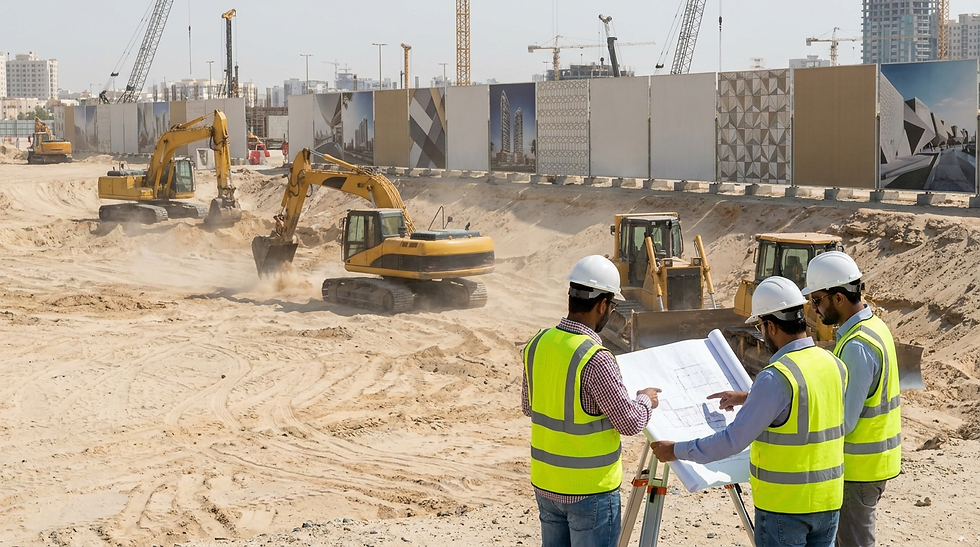
Rowad Modern Engineering, a subsidiary of Elsewedy Electric Group, has begun construction on the expansion of Saudi Logistics Services Company (SAL) facilities at King Khalid International Airport in Riyadh. The project involves comprehensive rehabilitation of existing cargo infrastructure and the construction of new supporting facilities, all designed to lift capacity, efficiency and sustainability standards across SAL’s Riyadh hub.
Project Overview
The Riyadh works form part of a wider SAR 4.2bn (about $1bn) SAL logistics zone programme being developed in Falcon City, north of Riyadh, under a long-term land lease with Saudi entertainment and investment group Sela.
Key facts:
Client: Saudi Logistics Services Company (SAL)
Main contractor: Rowad Modern Engineering (Elsewedy Electric Group)
Location: King Khalid International Airport, Riyadh, linked to the planned SAL Logistics Zone at Falcon City in the Malham area north of the capital
Wider programme value: Around SAR 4–4.2bn ($1–1.06bn) for the logistics hub in Falcon City, on a site of about 1.56–1.6 million square metres
Lease structure: 30-year lease with Sela, extendable by 15 years, with a three-year grace period
Strategic context: Part of Saudi Arabia’s National Transport & Logistics Strategy and Vision 2030 objective to position the Kingdom as a global logistics hub
Delivery Partners and Key Stakeholders
The scheme connects multiple layers of Saudi and regional logistics actors.
SAL Saudi Logistics Services: National air cargo and logistics operator, driving the investment as part of its long-term strategy to build world-class handling, warehousing and distribution capacity in Riyadh
Rowad Modern Engineering: Egyptian general contractor responsible for managing, executing and delivering the Riyadh facilities expansion across all phases, in line with high technical and engineering standards
Elsewedy Electric Group: Parent company of Rowad, bringing regional experience across power, ports, renewables and industrial works
Sela Company: PIF-backed entertainment and investment firm, master developer and landholder of the Falcon City site, leasing roughly 1.5–1.6 million square metres to SAL for the logistics zone
Saudi government and regulators: The project sits under the umbrella of Vision 2030, the National Transport & Logistics Strategy and aviation regulators at King Khalid International Airport
Rowad is also executing other high-profile Saudi projects, including the Red Sea Museum, Ministry of Culture headquarters in Diriyah and Al-Ha’ir developments in Riyadh, signalling that this is not a one-off market entry but part of a growing KSA portfolio.
Construction and Technical Details
Rowad’s scope in Riyadh covers both refurbishment of live operational assets and delivery of new-build logistics infrastructure.
The works include:
Rehabilitation and upgrading of existing SAL cargo and logistics infrastructure at King Khalid International Airport, modernising architectural, structural and MEP systems
Construction of new supporting facilities and services, likely including expanded warehousing, handling areas, offices and ancillary buildings to support future phases of the Falcon City logistics programme
Sustainability-focused design and delivery, with an explicit target of achieving LEED Gold certification
Operational continuity planning, with a phased construction strategy that maintains uninterrupted airport operations and cargo flows while works are executed in a live environment
The Riyadh airport expansion works complement SAL’s broader logistics build-out, which already includes a 45,000-square-metre distribution centre at The Logistics Park in southern Riyadh, featuring a Transport Control Tower Hub and advanced warehousing systems. The new project at King Khalid International Airport further integrates SAL’s airside and landside logistics capabilities.
Timeline
The SAL Riyadh logistics programme has unfolded in stages.
March 2025: SAL signs a preliminary agreement with Sela to lease around 1.5–1.56 million square metres of land in Falcon City, north of Riyadh, to develop and operate a logistics zone with investments of about SAR 4–4.2bn
Late 2025: SAL signals plans to allocate around 20% of the project’s value to infrastructure development in 2026, aiming to complete Phase 1 by 2027 and full build-out by 2030
October 2025: Final land lease agreement between SAL and Sela is signed, confirming the 30-year lease with an option for a 15-year extension and a three-year grace period
October 2025: SAL opens a 45,000-square-metre distribution centre at The Logistics Park in southern Riyadh, boosting its warehousing and distribution capacities
March 2026: Rowad Modern Engineering announces the start of development and expansion works for SAL’s facilities at King Khalid International Airport in Riyadh, marking the execution phase of the airport logistics hub component
2026–2027: Phased delivery of upgraded and expanded facilities at the airport, aligned with SAL’s broader Falcon City programme and Vision 2030 logistics milestones
Strategic Importance
Saudi Arabia’s National Transport & Logistics Strategy aims to position the Kingdom as a global logistics hub linking three continents. The SAL logistics programme in Riyadh, combining Falcon City and the airport hub, is a central piece of that ambition.
The Riyadh logistics ecosystem now encompasses:
A massive 1.5–1.6 million-square-metre logistics zone in Falcon City with Class A warehouses, scalable storage and multimodal connectivity
An expanding network of advanced distribution centres, including the Logistics Park facility in southern Riyadh
Upgraded cargo and logistics facilities at King Khalid International Airport, designed and built to LEED Gold standards
Bringing in Rowad Modern Engineering, an Egyptian contractor, adds a regional integration dimension to this story. It demonstrates that Vision 2030’s logistics build-out is drawing not just global operators and consultants, but also regional mid- to large-cap contractors capable of delivering complex projects in live environments. That deepens the regional supply chain, spreads opportunity beyond Saudi borders and signals confidence in Egypt’s engineering capacity.
At a macro level, logistics and cargo infrastructure are among the most quietly important components of Saudi Arabia’s wider Vision 2030 build-out, underpinning trade flows that support tourism, industry, e-commerce and giga-project supply chains.
Writer’s Opinion
The SAL Riyadh logistics project is a good example of how Vision 2030 often works in practice. The headlines focus on giga-projects and spectacular tourism schemes, but the real backbone is built through cargo centres, warehouses and logistics zones that make trade more efficient and reliable.
Rowad Modern Engineering’s involvement is significant on several levels. It shows that Saudi Arabia’s logistics push is not a closed shop for domestic contractors and a handful of global giants. Regional players, especially from Egypt, are being pulled into the value chain. For Rowad, already active on high-profile cultural and government projects in the Kingdom, delivering a LEED Gold logistics hub in a live airport context will be a powerful reference.
The real test will be integration. SAL is building a layered network: Falcon City in the north, The Logistics Park in the south, airport facilities in the middle. If those elements function as a cohesive system, with digital control towers, standardised processes and truly multimodal connectivity, Riyadh’s logistics proposition will become compelling. If they remain siloed projects, each impressive on its own but weakly integrated, the full Vision 2030 logistics potential will be harder to realise.
Explore These Guides and Reports
Take it further
Funded pipelines, cost benchmarks and country by country analysis behind stories like this are covered in our Middle East, GCC and North Africa Construction Market Intelligence Report 2026, available now on the Emilecon store.