Oman Issues New Sultan Haitham City Tenders: Roads, Central Park and Infrastructure Packages Valued At $535mn
- Michael Ghobrial

- Mar 24
- 3 min read

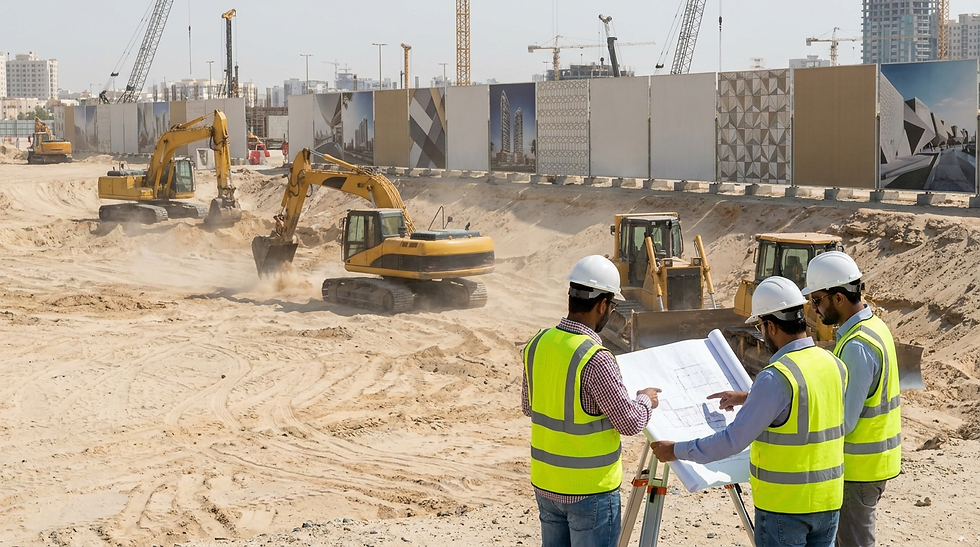
Oman’s Ministry of Housing and Urban Planning (MoHUP) has issued fresh construction tenders for Sultan Haitham City, including road connectivity to Sultan Qaboos Highway and a major central park, as phase one infrastructure works accelerate. Valued at tens of millions of Omani rials, the packages cover transport links, landscaping, green spaces and utilities, building on RO205 million in prior awards and supporting the city’s launch as a flagship new urban development west of Muscat.
Project Overview
Location: Sultan Haitham City, west of Muscat, Oman.
Client: Ministry of Housing and Urban Planning (MoHUP).
Tender packages: WP16 (road connectivity and utilities), WP09B (central park), plus Package 9 (streetscaping, park and rehabilitation complex).
Values: Individual packages in tens of millions of Omani rials (hundreds of millions USD total programme).
Scope: Roads, bridges, flyovers, drainage, utilities, landscaping, central park (45 hectares), wadi development.
Status: Tenders issued March 2026; bids due April/May 2026.
Programme context: Phase one (2024–2030), with 70% of tenders under execution and $535 million already awarded.
Explore These Guides and Reports
Delivery Partners and Key Stakeholders
Procuring authority: Ministry of Housing and Urban Planning (MoHUP) is issuing tenders, managing procurement and overseeing phase one delivery.
City developer: Sultan Haitham City Project Management Office coordinates masterplan execution, tender scoping and contractor coordination.
Prior awardees: Eight infrastructure packages (RO205m total) already awarded; new tenders build on this momentum.
Private developers: Firms like Retal Development (recent RO320m neighbourhood award at MIPIM 2026) partner on residential parcels.
Local authorities: Muscat Governorate oversees integration with Sultan Qaboos Road and regional connectivity.
End users: Future residents, workers and visitors to Muscat’s newest urban extension.
Construction and Technical Details
The WP16 tender covers external road links connecting Sultan Haitham City to Sultan Qaboos Road, including bridges, flyovers, underpasses, utility buildings, stormwater systems, culverts, wadi channels and medium/low‑voltage electrical works. Scope emphasises robust drainage and flood resilience, given Omani wadi dynamics, alongside seamless highway integration.
WP09B targets the 45‑hectare central park with structures, wet/dry infrastructure, landscaping, pedestrian paths, bridges, event zones, water features and open spaces. The park doubles as a connectivity hub between neighbourhoods, blending recreation with urban functionality.
Package 9 includes streetscaping (afforestation, pavements, decorative elements, urban facades), central park/wadi execution (1.64m sqm green space) and a rehabilitation complex for persons with disabilities. Works prioritise aesthetic and accessible public realms, with sustainable planting suited to arid conditions.
Technical challenges include phased delivery amid live sites, wadi flood management, utility coordination and high‑quality landscaping in a hot climate. Sustainability via native planting, efficient irrigation and durable materials supports Oman’s green‑city ambitions.
Timeline
Sultan Haitham City phase one (2024–2030) has seen steady tender activity: three service packages floated in 2024, eight infrastructure awards (RO205m) by early 2026, and 70% execution progress. Recent Package 9 tenders issued in January 2026.
WP16 tender published 13 March 2026; bids due 28 April, opening 29 April. WP09B bids close 3 May 2026. Awards expected mid‑2026, with construction starting late 2026/early 2027 and completions aligning with residential phasing (first units 2026).
Strategic Importance
Sultan Haitham City is Oman’s boldest urban project, a 15.4 sq km new city for 100,000 residents west of Muscat, easing capital pressure while showcasing sustainable masterplanning. New tenders unlock critical enablers: roads for access, parks for liveability and utilities for occupancy.
They support Oman’s Vision 2040 housing and economic diversification by creating a self‑contained urban node with jobs, amenities and green spaces. International exposure at MIPIM 2026 (Retal’s RO320m award) attracts FDI, while local content builds national capacity.
For regional construction, the pipeline sustains momentum post‑COVID, blending civils, landscaping and public buildings in a balanced, executable programme.
Writer’s Opinion
Sultan Haitham City’s tender cadence shows Oman prioritising delivery over fanfare: steady packages, clear scopes and realistic timelines let contractors bid with confidence. Roads and parks first is smart sequencing; without connectivity and green lungs, residential sales stall.
Contractors face familiar Gulf challenges: wadi resilience, phased live sites, and arid landscaping. Winners will excel in coordination, not just price. For Emilecon followers, this is a masterclass in public‑private urban development: MoHUP sets the infrastructure frame, private firms fill residential voids, creating mutual value. Oman’s model may prove more replicable than flashier neighbours.
Take it further
Funded pipelines, cost benchmarks and country by country analysis behind stories like this are covered in our Middle East, GCC and North Africa Construction Market Intelligence Report 2026, available now on the Emilecon store.